North Carolina
Navy Breaks Ground on First-of-Its-Kind Aviation Maintenance Complex in Kinston, Promising 400 Jobs Along the Neuse
By Dana Sutton · July 3, 2026
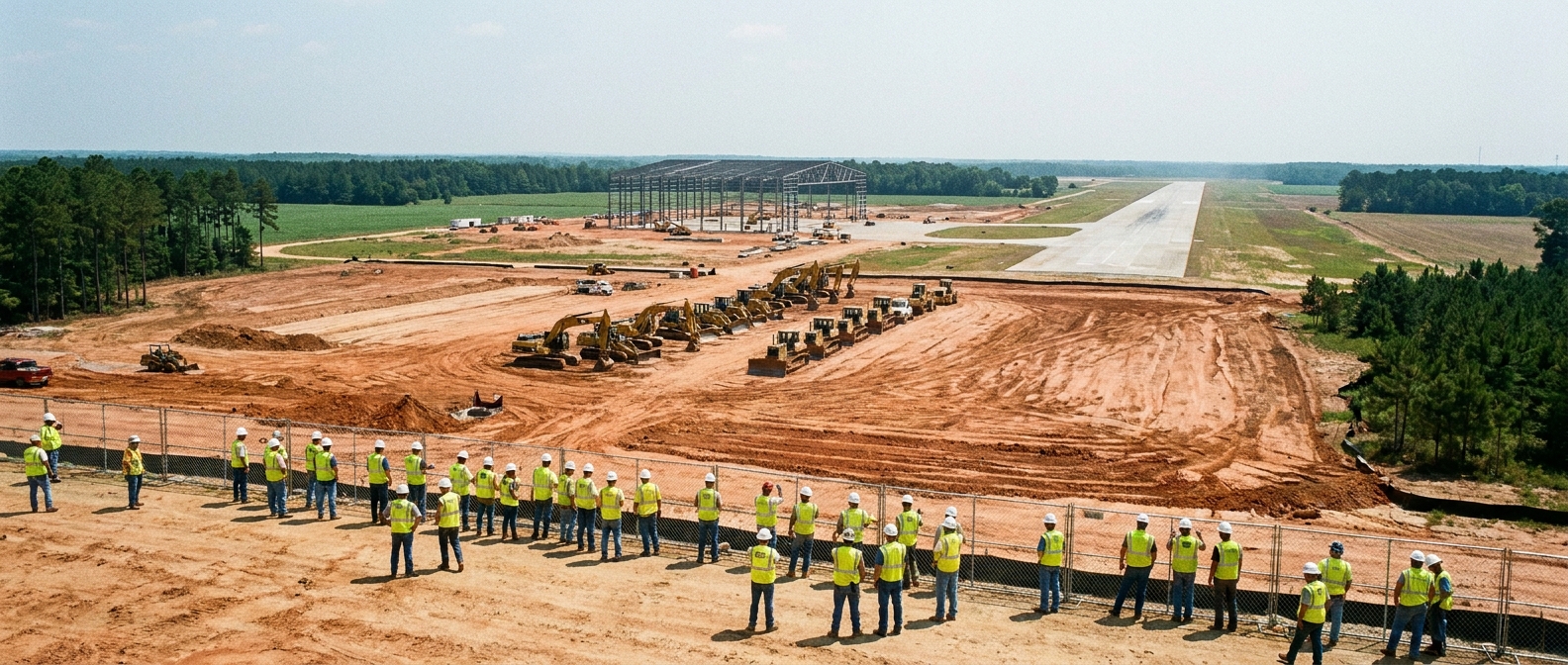
On June 25, the U.S. Navy and North Carolina broke ground on a Fleet Readiness Center East aviation maintenance complex at the North Carolina Global TransPark in Kinston—a first-of-its-kind federal-state partnership that will bring approximately 400 depot-level aviation maintenance jobs to a community along the Neuse River that has spent decades watching industrial work disappear. Governor Roy Cooper emphasized the investment's significance: "This FRC East expansion is a monumental investment in Eastern North Carolina that will create more than 400 great jobs to keep our C-130s in top flying condition".
The project represents a $500 million total investment, with North Carolina contributing $350 million and the Navy and Global TransPark covering the remainder.
A Partnership Built on State Risk
The partnership is structured through an Intergovernmental Support Agreement, a collaborative arrangement between the U.S. Navy and state government that allows sole-source contracts without Federal Acquisition Regulations competition. North Carolina state lawmakers approved the $350 million as a loan in 2023 to fund site improvements at the Global TransPark. The Navy signed a 10-year lease at $15 million per year that will take effect once FRCE fully occupies its 65-acre space at the TransPark. The state carries construction risk and only gets paid back if the facility actually opens and operates.
The arrangement is projected to avoid approximately $700 million in construction costs for the U.S. government and cut the construction timeline by more than 50%. That compressed schedule puts immediate pressure on a community that must build and staff a world-class maintenance facility faster than the military normally operates.
Preston Hunter, Executive Director of the NC Global TransPark Authority, acknowledged what everyone involved understands: "You know the old saying that, if it was easy, everybody would do it? There's a reason nobody is doing this but us".
In April 2026, Governor Josh Stein announced that the N.C. Global TransPark and the U.S. Navy had signed the 10-year agreement, bringing the project closer to operational status.
Work That Determines Who Comes Home
The facility will provide depot-level maintenance, repair, and overhaul on C/KC-130J Super Hercules, C/KC-130T Hercules aircraft, and HH-60W Jolly Green II helicopters. The complex will span approximately 700,000 to 722,000 square feet across a 75-acre site and includes a 418,000-square-foot hangar with 12 maintenance bays—infrastructure that must meet the same standards as established Navy facilities that have been doing this work for decades.
Fleet Readiness Center East is the Navy's primary depot-level aviation maintenance facility on the eastern seaboard, located at Marine Corps Air Station Cherry Point in Havelock, and serves as the Department of Defense's Vertical Lift Center of Excellence. Kinston is not replacing Cherry Point. It's extending its reach.
Capt. James M. Belmont, Commanding Officer of Fleet Readiness Center East at the time of the groundbreaking, emphasized the mission stakes: "It's so gratifying to see years of planning and effort come to fruition at this moment. Bringing this new workload into FRC East will allow our team to continue supporting the nation's warfighters well into the future by doing what we do best: providing our military aviators with the best quality products, delivered on time and at the best cost".
Matthew McCann, Head of FRCE's MRO Logistics Department, put the timeline in perspective: "Current projections have the aircraft service lives stretching until 2064. That means we're looking at about four decades of workload coming through, which will allow FRCE to provide long-term economic impact in the area and continue serving the warfighter for generations to come". Four decades of workload—if Kinston can maintain the quality and efficiency the Navy demands year after year.
A Region That Watched Opportunity Leave Town
Kinston sits along the Neuse River in Lenoir County, an area that historically depended on textiles and tobacco. Both collapsed. North Carolina's textile industry shed jobs from 293,600 in 1973 to 211,300 in 1986, with over 800 mills closing nationwide during that decade. In 2003, Pillowtex closed five plants, eliminating 4,000 jobs in the largest single-day layoff in NC history. Tobacco's decline after World War II—driven by global competition, mechanization, and trade agreements like NAFTA—devastated communities including Kinston, leaving empty buildings, job losses, and rising poverty.
Kinston has a population of 19,900 as of the 2020 Census, with 68.9% identifying as Black or African American and 24.7% as White. The poverty rate runs approximately 27.9% to 28.3%, with about 32% of children under 18 living below the poverty line. Unemployment sits at 6.9%, and median household income ranges from $35,250 to $38,493—significantly lower than state and national averages. These aren't just jobs. They're potentially life-changing wages for families that have watched opportunity leave town for decades.
Senate Majority Whip Jim Perry captured the stakes: "I really believe this is transformational for our entire region".
The project will generate over $111 million in labor income from operational employment and support up to 4,828 temporary construction jobs. But only if the region can deliver the skilled workforce the Navy requires.
An Experiment Three Decades in the Making
The North Carolina Global TransPark is a 2,500-acre multimodal industrial and aviation complex conceived in the 1990s to transition the region from agriculture to skilled labor and aerospace manufacturing. The site was selected in May 1992 after officials reviewed eleven proposals; the location was formerly a U.S. Navy training base built in 1944 for World War II and later became an abandoned airport. The Navy is returning to land it once owned, now improved and offered back by a state determined to prove its worth.
The Global TransPark's Part 139 Kinston Regional Jetport features an 11,500-foot runway—one of the longest on the East Coast—an FAA control tower, and uncongested airspace, enabling up to 1,500 support missions annually for nearby military installations. Its proximity to Cherry Point and other East Coast bases allows FRCE to serve Navy, Marine Corps, and Air Force fleets with reduced transit time, and a temporary move from Cherry Point to the TransPark proved operations could run more efficiently there. That test run convinced the Navy the partnership could work. It also set performance benchmarks Kinston must now meet permanently.
Fleet Readiness Center East at Cherry Point is North Carolina's largest employer east of Interstate 95, with over 4,000 employees, an annual payroll exceeding $275 million, and over $865 million in annual revenue. That's an established workforce ecosystem that Kinston must build from scratch while competing for skilled workers in the same regional labor market.
Tom Hendrickson, Chairman of the N.C. Global TransPark Authority's Board, framed the partnership as mutual investment: "The new complex is a testament to the strength of our partnership with Fleet Readiness Center East. This project will bring high-quality jobs to the area, stimulate local businesses, and attract new investment to the GTP and the Region".
Governor Cooper emphasized North Carolina's military commitment: "As the most military-friendly state in America, I'm proud that the Global TransPark has become a magnet for aerospace investment that supports the mission of our fighting men and women".
Four Decades to Prove It
Construction is scheduled to be completed by September 2026, with C-130 work starting by the end of fiscal year 2026 and HH-60W work by fiscal year 2027. An aggressive timeline that leaves little room for delays or excuses.
State Transportation Secretary Joey Hopkins highlighted the stakes: "This facility represents a significant investment in North Carolina's future. We're pleased to support this project because it will mean a great deal to eastern North Carolina and better position the U.S. Navy to execute its mission".
The groundbreaking on June 25 wasn't the end of anything. It was the moment Kinston signed up to prove, day after day for the next forty years, that a community can keep Navy aircraft mission-ready. The hangar bays and tooling will tell one story. Whether those 400 jobs become careers, whether eastern North Carolina builds the workforce pipeline it promises, whether a region dismissed can deliver—that will tell another. The Navy is watching. So is everyone who stayed when the mills closed and the tobacco work dried up. This time, the test isn't whether anyone will give Kinston a chance. It's whether Kinston can take it.