Lifestyle
Goldsboro's Paramount Theatre Announces 2026–2027 Season: What a Full Calendar Says About Downtown's Pulse
By Staff · July 2, 2026
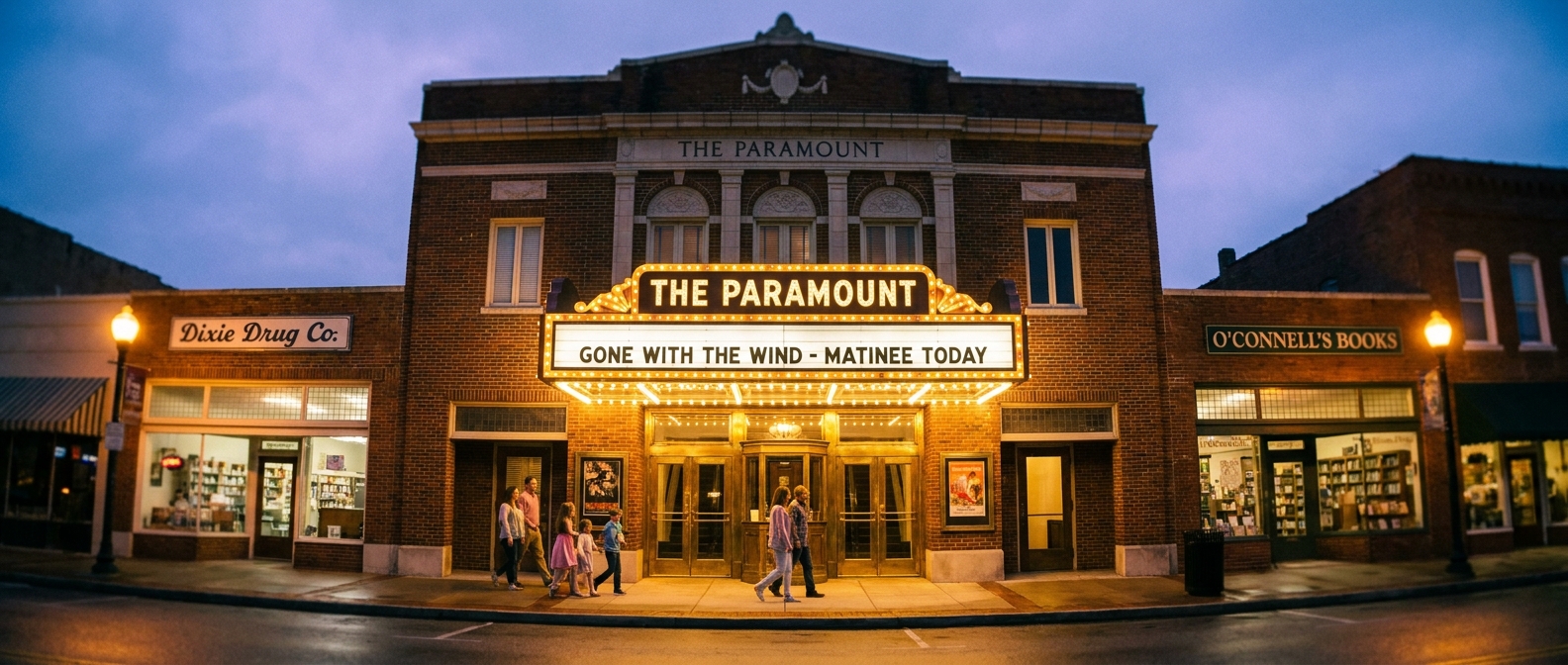
The Paramount Theatre in downtown Goldsboro just published its 2026–2027 season—nine months of shows locked in, October 30, 2026 through June 18, 2027. That might sound like routine arts news. It's not: it's a 500-seat theater in a small city with a median household income under $50,000 announcing it believes enough people will buy $20 tickets to keep the lights on for a full year. In a downtown that has weathered decades of economic contraction, a working theater with advance programming is not nostalgia; it's a test of whether cultural venues can still function as civic anchors. Can this place still get people to show up?
Downtown Goldsboro started bleeding out in 1968 when the last passenger train left Union Station. Foot traffic drained. Small businesses strangled. From the 1970s through the early 2000s, downtown was widely perceived as blighted as shopping malls and big-box stores moved economic activity away from the center. Then in the early 2000s, Goldsboro won a highly competitive $15 million federal transportation grant—only 3% of applicants win—which the city matched with additional capital. By 2015, Center Street was completely transformed. In the last 10 years, downtown Goldsboro has seen $80 million in public and private investment, 187 building rehabilitations, 78 net new businesses, 430 new jobs created—a 90% increase in job creation—and 100,000 square feet of space renovated and put back into use. In June 2026, downtown Goldsboro received Main Street America Accreditation, placing it among 49 North Carolina communities recognized for excellence in comprehensive downtown revitalization.
The Paramount itself embodies this arc. Originally constructed in 1882 as a three-story brick office building and armory, it became The Mason Theatre hosting vaudeville and films in the 1920s, then the Paramount—the top motion picture theater in Wayne County. A devastating fire destroyed the theater on February 15, 2005. The building was rebuilt and officially reopened in February 2008. The renovated building had been donated to the City of Goldsboro in 1993, which managed it for 12 years before the fire. Today it's a 500-seat performing arts venue at 139 S Center St., with approximately 350 seats on the lower level and 150 in the balcony.
The 2026–2027 season includes Charlie and the Chocolate Factory, Frozen: The Ballet with a Sing-Along version, Dance for Christ, The Magic of Jeki Yoo featuring renowned pianist Jeki Yoo, and Cinderella. The programming leans heavily on family-friendly titles and recognizable intellectual property—Disney adaptations, beloved children's stories—alongside a faith-based performance and a classical piano concert. Ticket prices range from $19.80 to $22.00. The 2025–2026 season followed the same pattern—Shrek The Musical, A Christmas Carol, Alice in Wonderland—with identical pricing: $22.00 for adults, $19.80 for children, seniors, and military. The consistency signals a theater targeting a broad, multigenerational local audience rather than niche arts patrons or out-of-town visitors.
No specific attendance figures are publicly available. One event in February 2024 was reported as a sold-out crowd, but detailed totals are not regularly disclosed. Ticket sales run through third-party platforms like Etix, which list sale dates and prices but not final attendance numbers. Without that data, assessing whether the theater draws across generations and from across the Neuse corridor—or relies on the same loyal base—requires inference from programming continuity and the fact that a full season was announced at all.
Context matters for reading that signal. Goldsboro has a 2026 population of 35,123, growing at an annual rate of 0.32%. Wayne County had an estimated 122,300 residents in 2025. The broader Neuse River basin encompasses roughly 2.5 million people. Goldsboro has a median age of 36.8 years, a median household income of $48,540, and a poverty rate of 22.76%. The population is predominantly Black or African American (52.56%) and White (35.48%). In that economic reality, $20 tickets are not trivial, and filling seats consistently is a real test of cultural relevance.
The Paramount Theatre Foundation, a 501(c)(3) nonprofit, funds operations through area partnerships, an annual sponsorship drive, and public gifts, with the City of Goldsboro listed as a donor/sponsor partner. The majority of operational funding comes from the foundation's nonprofit efforts rather than direct city budget allocations. The foundation reported revenue of $55,000 in FY2025 according to IRS Form 990. Its mission: financially support theatre operations, keep programming affordable, promote community welfare, and fund new equipment. David Weil serves as foundation president, a volunteer position reporting zero compensation. His family has historical ties to Goldsboro; his ancestors Henry and Soloman Weil built the original armory on South Center Street in 1882. Adam Twiss has served as Director of the Paramount Theatre since May 2019, overseeing performing arts programming, event management, fundraising, and marketing. A $55,000 annual budget for a 500-seat venue programming a full season means the operation runs lean—relying on volunteer leadership, community partnerships, and modest ticket revenue rather than major grants or endowments. Wayne County hosts several other cultural institutions including the Community Arts Council, the Stagestruck Theatre Company, and the Goldsboro Civic Ballet.
The Paramount's 2026–2027 season is not evidence of a cultural boom—it's evidence of persistence in the face of structural headwinds. The programming—family-friendly, recognizable, affordable—signals a bet on breadth over prestige, accessibility over exclusivity, and repeat local attendance over regional draw. Without public attendance data, the clearest measure of success is continuity: the theater keeps programming seasons, volunteers keep leading the foundation, and the city and sponsors keep contributing. Goldsboro has been an exemplary Main Street community for 40 years, leveraging partnerships, preservation, and strategic planning to drive incremental growth into a thriving, engaged downtown with diverse small businesses, public art exhibits, and cultural events. The Paramount is part of that broader ecosystem—but it's also a bellwether for whether $80 million in investment translates into regular foot traffic and community use.
The question is not whether the Paramount is thriving—it's whether it's sustainable. A $55,000 budget, volunteer leadership, and modest ticket prices suggest the answer depends on continued community buy-in, not institutional largesse. For now, the fact that the Paramount can publish a full season is a quiet but meaningful signal: downtown Goldsboro still has pull. Whether it can keep that pull as demographics shift and the audience ages is the next test.